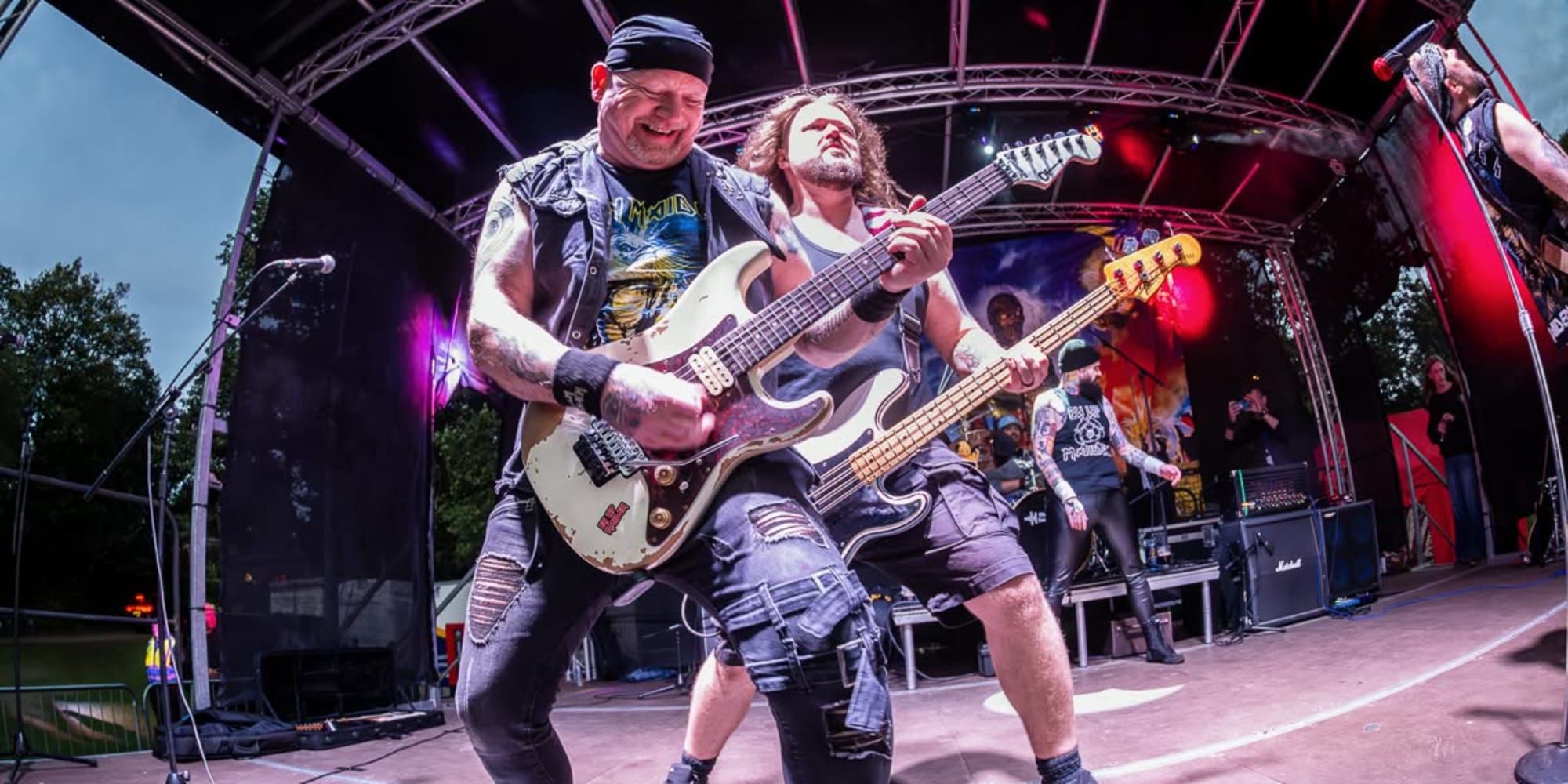
Plenty of venues that would love live music never book any because they assume their room can't handle it. No stage, one plug socket behind the fruit machine, a ceiling from 1780. We've played rooms with all three of those features, sometimes simultaneously, so take it from a working five-piece: the list of things a band genuinely needs is short, and most of what venues worry about doesn't matter.
Here's the honest checklist, written for whoever books the entertainment.
Space: about four metres by three
A five-piece with a drum kit fits comfortably in a floor area of roughly 4m wide by 3m deep. A raised stage is lovely and completely optional; some of the best gigs we play are floor shows with the crowd close enough to read the setlist. What matters more than square metres is shape: the drummer goes at the back, the amps beside the kit, and the three of us up front need enough room to not concuss each other during The Trooper. If your function room can host a wedding disco, it can host us.
Ceiling height only becomes a conversation below about 2.4m, and even then the conversation is usually just "mind your head, Jon".
Power: two ordinary sockets
A full band show, PA and lights included, runs happily off two standard 13-amp sockets on separate circuits. That's it. We carry our own extension distribution, tested and fused. What causes problems is one overloaded circuit shared with the kitchen's fryers, so if you know your wiring is temperamental, tell the band in advance and we'll plan around it. Venues have tripped mid-Hallowed Be Thy Name before now, and that song deserves better.
Sound: yours or ours, but decide early
Two setups exist and both are fine. Either the venue has an in-house PA and the band plugs into it, or the band brings everything. We carry a full rig sized for rooms up to a few hundred people, so a venue with no equipment at all is a normal booking for us, not a problem.
The one thing to flag early is a noise limiter. If your venue has one of those traffic-light boxes that cuts power when the room gets loud, say so at the time of booking, not at soundcheck. A limiter set at 95dB and an Iron Maiden tribute have fundamentally different ambitions, and while we can adapt the rig and the set to work with one, we can only do it if we know.
Time: load-in, soundcheck, and the bit venues forget
A realistic schedule for an evening show: the band arrives two to two and a half hours before doors, load-in takes 45 minutes, soundcheck takes another 45, and then we disappear until showtime. What we need from you during that window is access (an unlocked door and somewhere to park a van near it, even briefly) and a person: one named human who knows where the sockets are and what time you want us to finish.
The bit venues forget is the end of the night. We finish, the crowd leaves, and packing down takes about an hour. If your licence needs the building empty by a fixed time, tell us and we'll set the finish accordingly.
The paperwork you should ask for
Any professional act carries public liability insurance and uses PAT-tested equipment, and your own insurer or licensing officer may ask you to evidence both. Ask the band for certificates when you book; we send ours with the booking confirmation without being asked. A band that can't produce them is telling you something about the rest of their operation too.
Nothing else on the admin side should fall to you. Since the Live Music Act 2012, amplified live music before 11pm for audiences under 500 needs no extra permission on a premises licence, which we covered properly in our guide to booking bands for pubs.
What we handle so you don't have to
For every Ey Up Maiden booking: full PA and lighting if you need it, our own backline, insurance and PAT certificates on confirmation, a tech spec and stage plan sent in advance, and promotion of the date to our own following. Your side of the deal is space, sockets, access and an audience, and we can help with the audience too; our guide to running a sold-out tribute night is the playbook we wish every venue used.
If you've been assuming your room is too small, too odd or too under-equipped for live music, describe it to us and we'll give you a straight answer. Fees from £450, and the full pricing picture is here.
Frequently asked questions
How much space does a five-piece band need?
Roughly 4m by 3m of floor space. A raised stage is optional, and low ceilings are workable above about 2.4m. If the room hosts a disco, it can host a band.
What power does a live band need?
Two standard 13-amp sockets on separate circuits covers a full show including PA and lighting. Professional bands carry their own tested extension and distribution equipment.
Does the venue need its own PA system?
No. Bands like us carry a full PA and lights sized for club rooms. If you do have an in-house system, we'll happily use it; just agree which setup applies when booking.
What is a noise limiter and why does it matter?
A device that cuts power to the stage when volume exceeds a set level. Bands can work with limiters if told in advance, but a limiter discovered at soundcheck is the classic avoidable disaster.
What should I ask a band for before the show?
Public liability insurance certificate, PAT-testing evidence, a tech spec or stage plan, and arrival and finish times in writing. Professional acts provide all of this as standard.
Last updated: 4 September 2026.


